

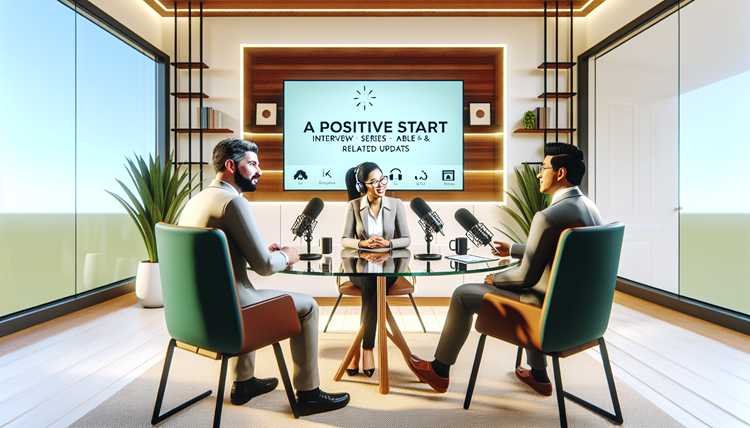
A Positive Start - Interview Series and Related Updates
Subscribe now to the interview series to receive actionable tips, concrete examples, and practical takeaways in your inbox each week.
In Season 1, we feature 12 guests across 6 fields, sharing real-world strategies, metrics, and templates you can apply right away. Each interview runs 14–22 minutes and ends with a concise recap you can skim in 90 seconds.
We publish new episodes every Tuesday, with a live Q&A on Fridays for a quick clarifying session. Transcripts accompany each episode, and you’ll find a compact checklist of action steps after every recap.
To stay in the loop, follow the show feed on your preferred platform, subscribe to the weekly recap, and save the episode notes in your notes app. Use the tag #APositiveStart to locate clips and key ideas.
Prepare your calendar: set a reminder for Tuesday mornings, skim the recap on Wednesday, and apply at least one tactic from each interview within 48 hours. A simple one-page template accompanies the notes to help you track progress.
Salina Grenet-Catalano: top priorities in France–Cyprus relations plus concrete action plans
See also: Conversation with the Ambassador toward CNA ELTR.
Recommend establishing a France–Cyprus Strategic Partnership Office (SPO) within six months to coordinate policy across energy, defense, education, and people-to-people ties, with quarterly reviews and a published action plan.
Within the SPO, form a Steering Committee of senior officials from foreign affairs, energy, defense, economy, and science agencies; appoint a dedicated liaison in Paris and in Nicosia; set up a joint budget line and a performance dashboard with 6–8 indicators covering energy interconnections, defense training days, and student mobility figures.
Key priorities
Energy. Align regulatory processes with EU energy security goals; advance the Cyprus–Greece–France energy corridor; push for a joint feasibility study on a subsea interconnector linking Cyprus, Crete, and southern France by 2026; identify 2–3 funding pathways within EU programs and member-state initiatives.
Defense and security. Establish a formal defense dialogue, expand maritime surveillance and risk analysis cooperation, and increase joint exercises to two per year; pursue access arrangements for humanitarian and search‑and‑rescue operations in Cypriot waters; share cyber defense best practices through a dedicated working group.
Education, science, and culture. Grow mobility and joint research through Erasmus+ and tied PhD programs; target a 40% rise in student exchanges within three years; launch at least 3 joint PhD cohorts in engineering and environmental sciences; create a Cypriot–French university cooperation fund to seed new centers of excellence.
People-to-people and economy. Simplify visa and business procedures for researchers and startups; establish a bilateral investment framework with clear timelines and dispute-resolution channels; convene a France–Cyprus business council with quarterly meetings to catalyze 3–5 flagship projects per year.
Concrete action plans and milestones
Year 1. Operationalize the SPO in Paris and Nicosia; sign MOUs on energy regulation, defense cooperation, and academic exchange; appoint project teams; launch a joint data portal and publish the first action plan by Q4; set up 2–3 working groups with monthly coordination calls.
Year 2. Initiate two energy feasibility studies and a regulatory alignment review; hold two ministerial dialogues; launch 3 mobility programs and 1 joint research center; establish the France–Cyprus Business Council with 4 working groups.
Year 3. Move to procurement and implementation of at least one interconnection study; finalize 2–3 PhD programs and 1 cross-border research initiative; sign a bilateral trade and investment framework; track progress with a dashboard covering 8 indicators and publish annual results.
Olympic Truce in practice: how peace proposals address Ukraine plus the Middle East
Adopt a clearly defined Olympic Truce window aligned with the Games calendar: from 14 days before the opening ceremony through 14 days after the closing ceremony, with explicit protection for civilians, humanitarian corridors, and medical facilities. Appoint a joint IOC-UN monitoring unit to track compliance and publish public alerts of violations.
Ukraine-focused proposals combine short-term ceasefires in frontline zones with guaranteed aid access and safe routes for food, medicine, and essential services. Proposals require humanitarian corridors supervised by ICRC, UN agencies, and local authorities, plus protection for medical facilities and schools.
Middle East initiatives push for pauses in Gaza and other frontline regions, along with de-escalation steps, humanitarian corridors, and confidence-building measures such as prisoner exchanges. These moves should be paired with transparent access for humanitarian workers and journalists to document needs and deliver relief.
Both tracks share practical actions: pre-designated routes for aid convoys and medical teams; independent observers along corridors; safe passage for journalists and humanitarian workers; and a public data dashboard showing incidents, aid deliveries, and movement of people involved in relief efforts.
Implementation rests on concrete signatories from key states and regional bodies, a clear civilian-exemption framework, short-term triggers to extend or adjust the truce, and explicit commitments for media safety. Establish a mechanism to review progress after each Games cycle and publish findings to inform future peace proposals.
Impact is measurable through civilian casualty trends, the number of aid convoys completed, hours without shelling near critical facilities, and uninterrupted travel for athletes and essential personnel. Regular, neutral reporting helps communities assess progress and keeps political actors accountable.
2024 Olympics: schedule, venues, plus opportunities to Cypriot participants
Coordinate with the Cyprus Olympic Committee and your sport federation now to confirm entry routes and a training plan for Paris.
Schedule highlights
Paris runs July 26–August 11, 2024. The opening ceremony takes place on July 26. Finals for athletics, swimming, and other core events cluster in the last days of the program, with cycling and tennis delivered in the middle and later weeks. Tennis takes place at Roland-Garros; golf is staged at Le Golf National; sailing operates from Marseille along the coast. Events unfold across Île-de-France and coastal sites, enabling efficient travel between venues for athletes and staff.
Opportunities for Cypriot participants
Direct qualification slots are earned when a Cypriot athlete meets the standards set by sport federations and the IOC. If a direct slot isn’t secured, universality entries may be explored through the Cyprus Olympic Committee in cooperation with IOC Solidarity programs. Reach out to your federation early to review current criteria and trial dates, and align training camps with international events to gain competition exposure. Prepare travel documents, medical clearance, and accreditation in advance, and ensure coaches and medical staff have the necessary credentials. The Cyprus team can coordinate with European federations for late qualification windows and shared training camps near competition weeks.
Bilateral relations in focus: practical cooperation; also Grenet-Catalano’s wishes to the Cypriot people

Launch a 12-month cross-border energy and water-management pilot to strengthen practical cooperation between the two sides.
- Establish a joint task force with equal representation to design an interconnector for electricity with 100 MW capacity in phase one, plus a grid-code alignment by Q3.
- Set up a shared desalination and irrigation plan to reduce drought risk, with data-sharing on rainfall and groundwater levels.
- Create a streamlined business visa and customs process for goods and tourism, targeting 20% faster clearance for priority sectors by year-end.
- Coordinate research in renewables, grid resilience, and cyber security for critical infrastructure, with annual joint workshops.
- Consolidate emergency-response cooperation, including medical support, search and rescue, and cross-border rapid alerts.
Grenet-Catalano’s wishes to the Cypriot people reflect ongoing support for peace, prosperity, and civic resilience.
- Safety for families and towns across the island.
- Prosperity through entrepreneurship and local industries.
- Continued dialogue that involves communities, youth, and civil society.
- Solidarity with humanitarian efforts and cultural exchanges.
These steps offer concrete benefits for citizens and institutions alike, aligning diplomatic intent with on-the-ground results.
WM Issue 5: highlights, reader questions; also implications to policy discussions
Publish a concise data appendix within seven days, listing sources, methods, and a plain-language summary to support policy discussions.
Highlights from WM Issue 5 include a 12-question reader survey, three rapid-case studies, and two expert insights. The top takeaways target immediate actions: launch a limited pilot with measurable outcomes, set a 90-day review cadence, and align pilot criteria with existing regulatory standards.
Reader questions address scalability, funding, privacy, and accountability. Key inquiries include how results scale to different communities, what funding streams cover pilots, how privacy is protected when sharing datasets, and how outcomes are tracked and publicly reported.
Policy implications offer concrete paths: require transparent data practices, publish a public dashboard on pilot results, and establish independent audits of claims. Public dashboards and quarterly reports should accompany any pilot funding, with clear criteria for termination if metrics fail to meet thresholds.
| Topic | Reader Question | Policy Action |
|---|---|---|
| Data sharing | Which datasets are released and under what terms? | Adopt a data-sharing policy with documented licenses and a redaction plan. |
| Privacy safeguards | How are privacy risks mitigated in shared data? | Require privacy impact assessments and, where appropriate, differential privacy techniques. |
| Pilot funding | What funding streams cover early pilots? | Establish a dedicated grant track and a 12-month reporting cadence. |
| Accountability | How will outcomes be tracked and publicly reported? | Implement quarterly dashboards and an independent verification process. |
| Stakeholder input | How are educators and community groups included? | Set up advisory panels with rotating members and a public comment window. |
Exclusive interview: Rwanda’s Minister of Environment on International Women’s Day–policy priorities and actions
See also: What Fitch upgrade changes island’s sovereign rating, plus....
See also: CUS News Report.
Increase funding for community-based environmental monitoring by 20% in the current budget cycle and allocate 60% of grants to women-led groups.
Rwanda’s policy plan for the next five years calls for 9 million trees planted, with women-led cooperatives guiding 40% of reforestation work and 50% of nursery activities. The goal is to restore degraded land and expand urban green spaces by 2029.
The ministry will publish disaggregated data on forest cover, biodiversity indicators, soil health, and waste management annually, with an open dashboard available to districts and citizens by 2025. This transparency allows local authorities to target gaps and track progress month by month.
Budget lines direct 60% of frontline staff in field programs to women, and set a 40% target for leadership roles within ministries and partner agencies by 2027. Districts will receive capacity-building grants to strengthen women-led environmental groups.
Support for rural producers includes training on agroforestry, soil conservation, and climate-resilient planting, coupled with micro grants up to 2,000 USD to women farmers for equipment and seeds. These measures connect conservation outcomes to livelihoods.
Policy priorities
The ministry prioritizes forest protection, watershed management, and clean streets. We will revise the forest code to tighten penalties for illegal logging and accelerate licensing reforms to reduce bureaucratic delays for community-managed forests. A new biodiversity action plan will align with regional initiatives to safeguard critical species and promote eco-friendly tourism in protected areas.
We will expand urban greening by integrating green corridors into city plans, install 50 new composting sites in major towns, and launch a waste separation pilot in 12 districts to reduce landfill waste by 18% in three years. All programs will incorporate gender-responsive budgeting and inclusive governance at the district level.
Actions on the ground
National teams will train 1,500 community educators in environmental literacy for schools and adult programs. Field operations will deploy 100 rangers to border zones to deter illegal wildlife trade and protect habitats, with women composing 40% of ranger corps over the next four years.
Districts will establish 300 community monitoring centers that record water quality, soil moisture, and plastic pollution. Each center will mentor 25 women-led groups and support micro-networks for sustainable farming, composting, and waste recycling. A national procurement policy will prioritize recycled materials and locally produced tools to create green jobs.
A Positive Start recap: key insights from the Salina Grenet-Catalano interview and next steps
Implement a 90-day objective with one primary metric and weekly check-ins to monitor progress.
Salina Grenet-Catalano highlights prioritizing a single user outcome and testing two small experiments every two weeks to validate ideas before scaling.
Salina Grenet-Catalano recommends a compact cross-functional squad of four: product, engineering, design, and research, with shared ownership and 2-week cycles.
Set up a lightweight data tracking: a dashboard with three core metrics, a 15-minute daily standup, and a 60-minute weekly review to decide which experiment to roll forward.
Next steps involve compiling insights into a one-page plan, distributing it to stakeholders, and scheduling a kickoff meeting within the next week.
Ready to set up your Cyprus company?
Our specialists guide you through the entire process — registration, tax setup, and bank account opening.
Request a consultation →