

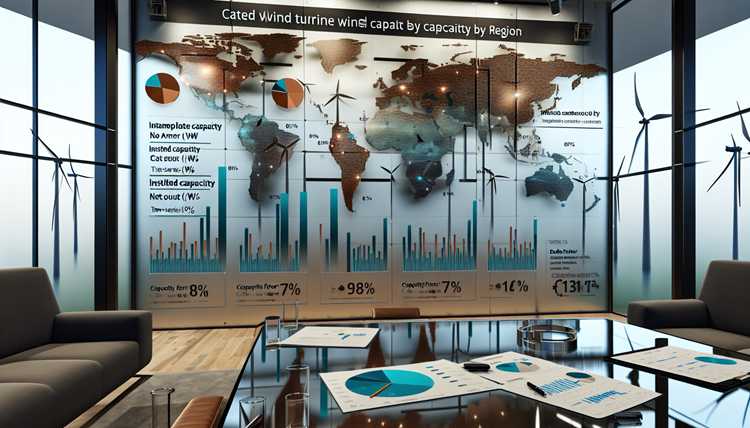
Calculating turbine capacity by region - data sources, nameplate vs net output, capacity factor
Begin with net-output data by region and compute capacity factors for apples-to-apples comparison. This approach reveals true utilization and avoids overestimating capacity when wind farms operate below rated output.
To build a reliable regional view, pull data from a mix of official registries and international aggregators. Key sources include national energy agencies, the U.S. EIA, IRENA's Renewable Capacity and Generation datasets, the BP Statistical Review, and ENTSO-E's transparency platforms. Align data to a common year and note revisions where needed.
How to compute capacity factor: Capacity factor by region is net output divided by the product of installed nameplate capacity and hours in the period: CF = Net Output / (Nameplate × Hours). Use hours in the period (8760 for a non-leap year) or the actual hours in the year if using annual data. Present CF as a percentage to enable cross-region comparisons. Use net generation for the numerator, not billed energy or capacity credits; ensure units align (MW, MWh, etc.).
Distinguish nameplate capacity (the total theoretical output) from net output (the actual energy delivered after curtailment, losses, and interconnection constraints). Nameplate signals potential, net output reflects real performance. Offshore sites often show higher CF than onshore due to steadier winds; typical onshore CF ranges from 25% to 40%, offshore commonly 40%–50% depending on wind regime and water depth. Regional policy, grid topology, and seasonality drive these differences; document assumptions when you publish regional CF results.
Practical steps: harmonize time frames and units across data sets; note the year, region boundary, and whether the data include temporarily offline turbines; when data are missing, interpolate cautiously or mark as missing; use net output for capacity factor to enable fair cross-region comparisons; report sensitivity bounds if you apply different time windows or weather corrections. This keeps regional capacity assessments robust for planning and policy discussions.
Assessing transmission, grid upgrades for incremental MW: congestion, reinforcement, interconnection timelines
See also: Towards Clean, Green Futures.
Recommendation: Prioritize reinforcement on the highest-congestion corridors and lock in interconnection timelines with the ISO. Create a rolling 12-month schedule that ties turbine procurement milestones to grid upgrades, ensuring installations proceed in parallel with permitting and construction milestones.
Data sources
- ISO/RTO congestion maps and ATC data (PJM, CAISO, NYISO, MISO, ISO-NE, SPP)
- Interconnection queue data from FERC filings and ISO portals
- Regional Transmission Plans (TIPs) and long-term plans showing planned upgrades and capacity additions
- Engineering studies: System Impact Studies, Facilities Studies, and Network Model updates
- Cost benchmarks: typical ranges for reinforcement capex per MW and line upgrades per MW-mile
- Permitting timelines from state and federal agencies; NEPA/SEPA requirements
- Historical project lead times from operator reports and project filings
See also: Valentinos Polykarpou and Limassol.
Key metrics to track
- Constrained corridor share of regional transfer capacity; monitor quarterly changes
- Average ATC change on top congested corridors
- Queue duration: time from filing to final study approval
- Cost per MW of reinforcement by corridor and project class
- Planned energization date vs. actual energization date for completed upgrades
- Reliability indicators (e.g., LOLE reductions) attributed to grid upgrades
Implementation steps
- Baseline assessment: catalog current queue MW, existing and planned upgrades, and current outage rates for top congested corridors
- Scenario planning: develop three incremental MW cases (e.g., 200 MW, 500 MW, 1,000 MW) and map required upgrades, costs, and timelines for each
- Procurement alignment: synchronize turbine procurement milestones with upgrade schedules; enable phased deployment where feasible
- Risk management: identify funding gaps, regulatory delays, and supply-chain risks; set buffers and contingency plans
- Monitoring: implement monthly progress reviews, with quarterly stakeholder briefings and milestone reassessments
Interconnection timelines: practical bands
- System Impact Study: 6–12 months
- Facilities Study: 6–12 months
- Construction and energization: 12–48 months, depending on scope and environmental permitting
Parallel actions to trim total lead time
- Pre-approve right-of-way acquisitions where permitted to reduce permit bottlenecks
- Adopt modular design and modular substations to shorten construction windows
- Run environmental reviews concurrently with turbine procurement and advancement of design work
- Engage stakeholders early to mitigate local permitting risks and reduce revision cycles
Permitting, site evaluation checklist for new farms: resource assessment, environmental surveys, community agreements
Implement a formal, data-driven resource assessment plan that captures wind speed and direction, hub-height wind shear, turbulence intensity, and grid-connection constraints. Document all assumptions and update the plan after each data collection cycle.
Ensure a minimum of 24 months of on-site wind data or 12 months of validated remote-sensing data at hub height, and apply terrain corrections. Define a clear decision point at 24 months to finalize turbine sizing and layout, incorporating uncertainty ranges.
Resource assessment checklist
Wind resource: install a meteorological mast or use validated remote sensing; confirm hub-height equivalence or adjust with a shear exponent; verify data completeness and quality flags before proceeding to modeling.
Site layout: model inter-turbine distances to limit wake losses; plan corridors and staging areas that minimize habitat disturbance and comply with land-use setbacks.
Grid interconnection: perform a preliminary interconnection study, confirm capacity at the local substation, and outline required upgrades, schedule, and rough cost range.
Terrain and environment: map slopes, drainage, soils, and flood risk; document erosion potential and land-use constraints; verify distances to residences and protected features per local rules.
Environmental surveys and community agreements
Environmental surveys: conduct avian and bat assessments with seasonal windows, obtain wildlife agency endorsements, and implement avoidance or deterrence plans; assess wetlands, streams, soils for contamination; evaluate cultural resources and secure permits where needed.
Noise and shadow: model expected sound levels at nearby receptors and assess potential flicker impacts; specify mitigation measures if thresholds are approached.
Community engagement: host early meetings, publish a community benefits plan, and draft a memorandum of understanding with landowners and local authorities; include dispute resolution, agreed reporting, and benefit-sharing commitments.
Contracting and governance: establish road-use agreements, staging rights, and seasonal restrictions; outline a decommissioning plan and a financial surety; set annual reporting cadence and independent audits for stakeholder groups.
Financial modelling for turbine projects: capital costs, O&M, PPA structures, payback projections
Start with a single integrated model that ties capex, O&M, and PPA cash flows to the project timeline. Build three modules: Capex, O&M, and Revenue. Use a base-case with capex per MW, O&M per kW-year, and a 12–20 year PPA that reflects local market terms. Run sensitivity on capacity factor, PPA price, debt terms, and inflation.
Key cost components and inputs
Capex (overnight) for onshore wind typically ranges from 1,100 to 1,500 USD per kW (1.1–1.5 M USD per MW). Offshore wind capex ranges from 3,000 to 5,000 USD per kW (3.0–5.0 M USD per MW). Breakouts matter: turbine price 0.70–0.95 M USD per MW, BoP 0.15–0.30 M USD per MW, grid connection 0.10–0.30 M USD per MW. Include contingency 5–10% for early-stage projects.
O&M costs split into fixed and variable parts. Onshore fixed O&M typically 25–40 USD per kW-year; variable O&M 2–8 USD per MWh. Offshore O&M fixed 60–120 USD per kW-year; variable 6–12 USD per MWh. Factor in admin, spare parts, vessel access, and corrosion protection in offshore budgets. Include a one-time capitalized replacement reserve for major components every 12–15 years if needed.
Financing terms shape returns. Use debt at 4–6% interest rate with tenor 12–20 years, target DSCR around 1.25–1.35 under base CF; equity hurdle around 12–18% IRR. Apply inflation assumptions to O&M and CAPEX escalations; prefer nominal modeling for cash flows unless project currency is fixed.
Incentives and taxes differ by region. Include available investment credits, depreciation schedules, and any production-based subsidies. Build a separate sensitivity for tax shields and grant support to reflect changes in policy.
PPA structures and payback projections
PPA types vary. Fixed-price PPAs with annual escalators 0–3% fit long-term hedging, while indexed PPAs tie price to CPI or wholesale market indices. Include take-or-pay clauses, volume caps, and curtailment risk in revenue forecasts. Include true-up mechanics for performance penalties or revenue adjustments at year-end.
Payback projections rely on cash flow clarity. Forecast annual net cash flow after debt service, taxes, and maintenance. Compute NPV at the project WACC and the internal rate of return (IRR) for equity. Target an NPV above zero and an IRR in the 8–12% range, with a DSCR above 1.25 in stressed years. Use LCOE versus PPA price to sanity-check economics: if LCOE sits at 3–5 cents per kWh and PPA price is 4–6 cents, the project should show a multi-year positive cash balance.
Projecting capacity growth, technology shifts to 2035: turbine scaling, offshore deployment, policy scenario impacts
Recommendation: Align turbine scaling with grid needs by deploying 12–16 MW onshore machines by 2030 and accelerating offshore platforms to 20–40 MW by 2035, with 40–60 MW floating concepts piloted in select basins. Build modular blades and scalable nacelles to reduce LCOE, and pair turbine evolution with port and grid upgrades to minimize curtailment during ramp-up.
Under three policy trajectories, projected cumulative capacity by 2035 differs significantly. Aggressive policy yields 180–260 GW of offshore wind globally, with 40–60 GW of annual additions by 2032–2035. Moderate policy reaches 110–180 GW, averaging 25–40 GW per year. Slow policy stays near 60–110 GW total, at about 10–20 GW annually. Onshore capacity tracks a similar gap, rising from today’s 2–4 GW/year to 6–12 GW/year in the high-policy case. Regional drivers include North Sea expansion, US East Coast repowering, and rapid growth in Asia-Pacific coastal markets.
Technology shifts unfold across three layers: turbine classes, offshore platforms, and grid integration. Onshore machines advance from 4–8 MW today to 12–16 MW by 2030 and 20–40 MW by 2035 in leading markets, supported by modular manufacturing to cut capex. Offshore fixed-bottom units target 20–40 MW by 2030–2035, while floating designs push toward 40–60 MW in suitable deep-water sites. Advancements in drivetrains, installation logistics, and remote diagnostics reduce balance-of-system costs and lift capacity factors by a few percentage points, accelerating project timelines by reducing permitting and mobilization friction in favorable markets.
Policy design shapes project speed and risk. Streamlined permitting, longer auction horizons, and stronger domestic supply-chain incentives can boost annual installations by 15–25 GW in mature markets and 5–15 GW in developing ones. Financial support mechanisms such as contracts-for-difference or targeted tax credits help lower financing costs by roughly 0.8–1.8 percentage points in early years. Grid readiness is essential: ensure HVDC interconnections, upgraded substations, and port infrastructure with transparent tendering and predictable timelines to reduce schedule slippage.
See also: Diversification of gas supplies.
To execute these shifts, set annual commissioning milestones, align procurement with domestic manufacturing programs, and fund pilot projects for floating and ultralarge offshore units. Use regionally disaggregated dashboards to track capacity additions by turbine class, deployment mode, and realized capacity factors, updating assumptions with policy and market feedback. Maintain flexibility in bids and financing models to absorb policy shifts and supply-chain constraints as 2030–2035 targets approach.
Ready to set up your Cyprus company?
Our specialists guide you through the entire process — registration, tax setup, and bank account opening.
Request a consultation →