
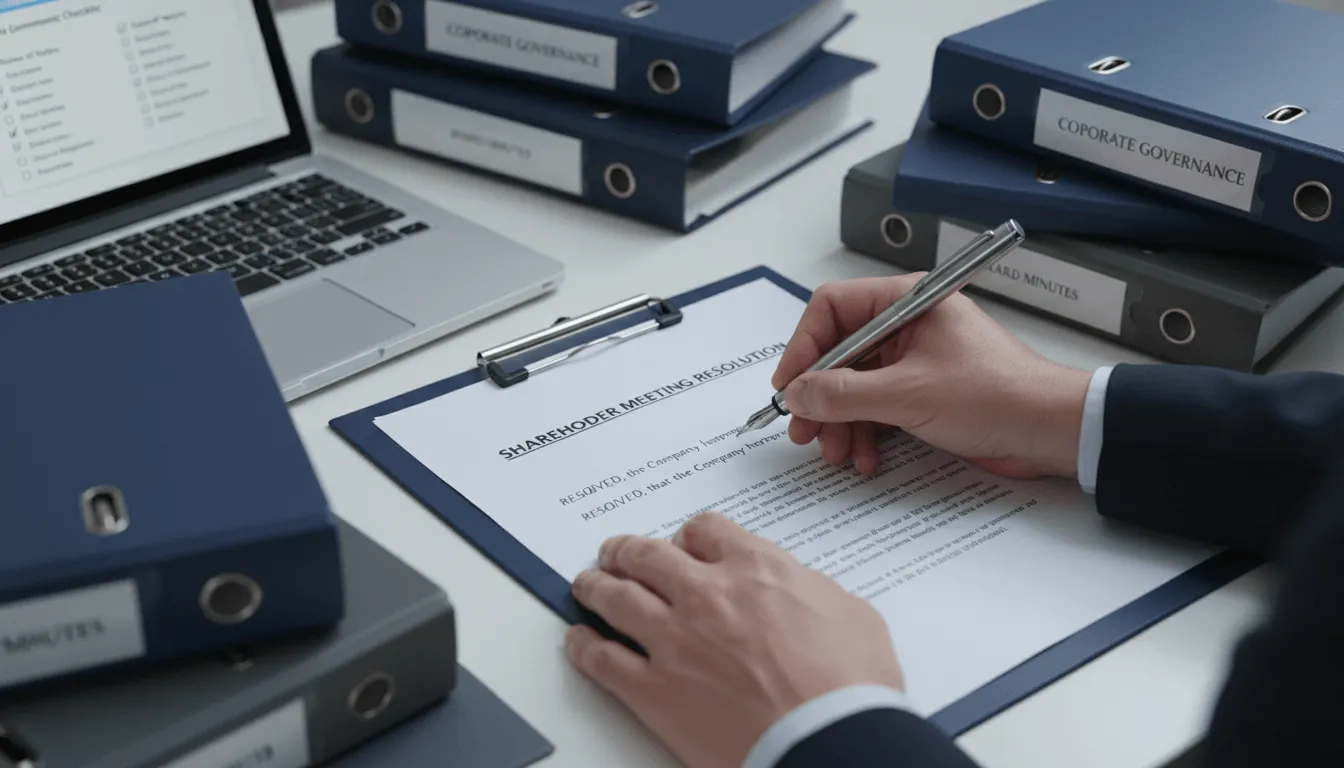
Corporate Governance Foundation: How to Prepare Legal Documents for Shareholder Meetings
Shareholder meetings—whether Annual General Meetings (AGMs) or Extraordinary General Meetings (EGMs)—are the cornerstone of corporate governance. They are the formal mechanism through which a company’s owners (the shareholders) exercise their fundamental rights, approve major decisions, and appoint directors. The legitimacy and legality of every action taken at these meetings depend entirely on the meticulous preparation and accurate drafting of the necessary Legal Documents for Shareholder Meetings. Poorly drafted resolutions, incorrect notice procedures, or incomplete minutes can expose the company and its directors to legal challenge, regulatory penalties, and shareholder dissent. For businesses operating globally, particularly within jurisdictions like Cyprus which adhere to stringent EU and common law corporate principles, precision is not optional; it is mandatory.
The Foundation: Understanding the Required Documentation
Legal Documents for Shareholder Meetings fall into three essential categories, each serving a distinct legal purpose and requiring careful attention to detail based on the company’s Articles of Association and the governing corporate law.
1. Pre-Meeting Documentation (Notice and Agenda)
See also: Company Formation.
The notice of the meeting is arguably the most critical document. It is the legal mechanism that validates the meeting itself.
- The Notice: Must be sent to all legally entitled shareholders within the statutory time frame (e.g., 21 days for an AGM in many jurisdictions). It must clearly state the date, time, and location (physical or virtual) of the meeting.
- The Agenda: This must list every item of business to be conducted, especially any item requiring a formal vote (a special resolution). Any resolution that is voted upon but was not mentioned in the notice or agenda may be deemed invalid.
- Proxies and Forms: Documentation must include the form of proxy, enabling shareholders who cannot attend to appoint a representative to vote on their behalf. The instructions for appointing and submitting proxies must be clear and compliant with the Articles.
2. Meeting Documentation (Resolutions and Minutes)
These documents record the core decisions and proceedings of the meeting. Correctly Prepare Legal Documents for Shareholder Meetings at this stage is essential for validating the outcomes.
- The Resolutions: Each resolution must be drafted precisely to reflect the action being proposed (e.g., "The appointment of [Name] as Director is hereby approved"). Resolutions are typically classified as ordinary (requiring a simple majority) or special (requiring a supermajority, usually 75%), which must be clearly indicated in the draft and recorded in the minutes.
- The Minutes: The minutes are the official legal record of the meeting. They must record the attendees, confirmation of quorum, a summary of the discussions, and the exact wording and outcome of every vote taken, including the percentage of votes for and against. Accuracy and completeness are paramount; minutes should be prepared immediately and approved by the chairman.
3. Post-Meeting Documentation (Filings and Registers)
The company’s statutory registers and regulatory filings must be updated promptly to reflect the changes approved at the meeting.
- Statutory Filings: Depending on the jurisdiction, certain resolutions (e.g., changes to the Articles, appointment of new directors, or issuance of new shares) must be filed with the Registrar of Companies within a very short statutory window. Failure to file correctly results in penalties.
- Register Updates: The Register of Directors and Secretaries, the Register of Members (Shareholders), and the Minutes Book must be physically or digitally updated to reflect the resolutions passed.
Advanced Tips on How to Prepare Legal Documents for Shareholder Meetings
See also: Company registration cyprus non resident.
The difference between a legally sound meeting and one vulnerable to challenge often lies in the details of the drafting process.
1. Cross-Reference with Articles of Association
Before drafting any notice or resolution, meticulously review the company’s Articles of Association. This document is the internal constitution of the company and dictates specific requirements for:
- The required length of the notice period.
- The definition of a quorum (the minimum number of shareholders required to be present).
- The required majority for specific types of resolutions. The prepared Legal Documents for Shareholder Meetings must align perfectly with these internal rules.
2. Draft Resolutions with Maximum Specificity
See also: Company registration cyprus corporate governance.
Ambiguity in resolutions is a common pitfall. Every resolution must be drafted to leave no doubt as to the scope or nature of the approved action. For example, a resolution to approve a director’s compensation should state the exact amount, frequency, and any conditions, rather than a vague statement of approval. When you Prepare Legal Documents for Shareholder Meetings, pre-draft the final version of the resolutions, rather than relying on an ad hoc formulation during the meeting.
3. Utilize Technology for Record Keeping
Modern corporate governance relies on technology. Use digital tools for maintaining accurate share registers and for sending out notices electronically (where permitted by law and the Articles). For virtual meetings, use secure, legally compliant voting platforms that automatically record the vote count, which simplifies the process of compiling the minutes and ensures a verifiable record of all proceedings.
4. The Importance of the Chairman’s Script
While not technically a legal document, a detailed Chairman’s Script is essential for ensuring that the meeting proceeds in a legally compliant manner. The script guides the chairman through the procedural steps: confirming quorum, formally putting each resolution to a vote, and correctly declaring the result based on the percentage required. This minimizes the risk of procedural errors that could invalidate the Legal Documents for Shareholder Meetings or the decisions they record.
In conclusion, How to Prepare Legal Documents for Shareholder Meetings is a process that requires a strong command of corporate law and a dedication to detail. By following the required statutory procedures, ensuring internal consistency with the company’s Articles, and drafting resolutions with absolute clarity, corporations secure the legitimacy of their decision-making, maintain sound governance, and protect the interests of their shareholders.
Ready to set up your Cyprus company?
Our specialists guide you through the entire process — registration, tax setup, and bank account opening.
Request a consultation →