

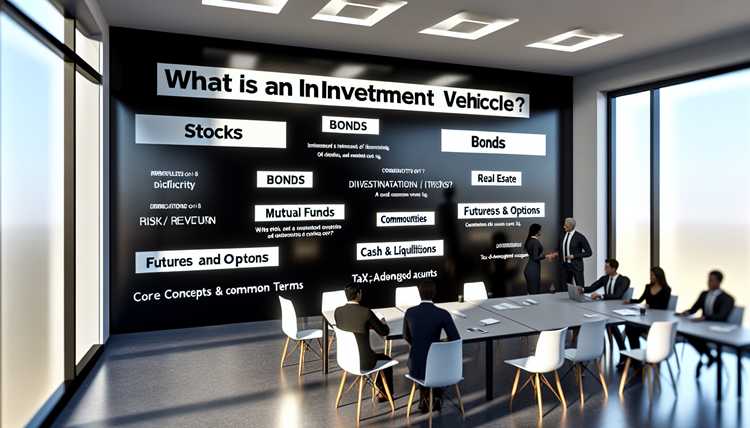
What is an Investment Vehicle? Core Concepts and Common Terms
Identify your goal and time frame first, then select a primary investment vehicle that fits. This approach keeps decisions practical and helps you compare options without guesswork. For instance, target a college fund in eight years or a retirement goal in two decades, and choose a vehicle that supports that horizon.
An investment vehicle is a framework that holds assets and defines how they are priced, traded, and taxed. It shapes risk and liquidity by combining investments with wrappers such as funds, trusts, or direct holdings. Understanding the wrapper helps you assess cost, access, and how gains flow to you.
Common vehicles include stocks and bonds for direct exposure, mutual funds and ETFs for bundled holdings, index funds for low fees, REITs for real estate exposure, and cash equivalents like certificates of deposit and T-bills for safety. Tax-advantaged accounts (IRAs, 401(k)s) change when profits are taxed and how you withdraw.
Costs matter: broad index ETFs typically charge 0.03%–0.25% in expense ratios, actively managed funds 0.50%–1.50%, and mutual funds can add trading costs or load fees. Liquidity varies: ETFs trade intraday, mutual funds settle daily, and direct equity positions settle as usual on exchange hours. Use this to estimate how quickly you can access funds.
To compare options, answer three questions for each vehicle: how well it aligns with your time frame, the level of risk you can tolerate, and the tax implications for gains and income. Start with a simple mix, then monitor performance for a year and adjust as goals evolve.
See also: Crypto and Second Citizenship.
As you build a plan, keep a core allocation in reliable vehicles and a satellite portion in higher growth options. Maintain a small liquidity buffer so you can cover unexpected needs without selling investments at a bad time. Document the reasons for each choice and revisit when life changes occur.
Choosing a Structure: Mutual Funds, ETFs, Index Funds, and Pooled Vehicles
Go with a low-cost, broad-market option – an index fund or ETF that tracks a wide total‑market index. Target expense ratios around 0.03%–0.20% per year and avoid funds with high turnover, sales loads, or opaque pricing.
Mutual funds and index funds often share structure, but mutual funds may carry higher annual costs when actively managed or loaded. Index funds are passive by design and typically offer lower ongoing fees. ETFs provide intraday trading, tax efficiency, and narrow spreads for popular funds; fees commonly run 0.03%–0.40% for core index ETFs, with more specialized or active ETFs higher.
Pooled vehicles such as fund‑of‑ funds or master‑feeder structures broaden diversification across managers or strategies but add layers of fees, often 0.5%–2% annually. They may suit investors seeking multi‑manager exposure or access to niche markets, yet they couple higher cost with more complex tax reporting and slower liquidity in some cases.
Minimums and access matter. Mutual funds commonly require $1,000–$3,000 to begin; some providers waive minimums. ETFs require only the share price and a brokerage account. Auto‑invest features exist for mutual funds; many brokerages also offer automatic ETF investment plans or recurring purchases.
Tax considerations influence choice in taxable accounts. ETFs typically deliver superior tax efficiency through in‑kind redemptions, reducing capital gains events, while mutual funds might distribute gains. In IRAs or 401(k)s, prioritize costs and alignment with your target allocation, since tax leakage is less of a concern.
Actionable approach: build a core with a broad‑market index fund or ETF to cover most equity exposure, then add a satellite sleeve only if you need exposure to small caps, international markets, or factor tilts. Keep the core in a single provider when possible to simplify rebalancing, and set regular contributions to maintain your allocation without chasing market timing.
Decoding Fees: Expense Ratios, Loads, and Hidden Costs
Start by selecting no-load funds or ETFs with all-in cost under 0.40% annually. For broad market exposure, target expense ratios below 0.20% and, where possible, under 0.10%. This keeps more of your returns working for you over time.
Expense ratios represent annual fees deducted from fund assets to cover management and operations. They are visible in the fund's prospectus and on brokerage quotes. For index funds and broad-market ETFs, typical ranges are 0.02% to 0.20%; actively managed stock funds commonly 0.50% to 1.50%; bond funds often 0.15% to 0.75%.
Loads are sales charges paid at purchase or sale. Front-end loads typically 3% to 5.75% of the amount invested. Back-end loads (contingent deferred sales charges) fade over 5 to 7 years and may still apply for early redemption. No-load classes exist and are widely available, especially for discount brokers. In addition, many funds levy 12b-1 fees of 0.25% to 0.75% per year to cover marketing and distribution.
Hidden costs influence net results as well. ETF spreads on liquid issues are usually 0.01% to 0.05% of trade value; thinner markets may exceed 0.20%. Funds with high turnover distribute more capital gains in taxable accounts. Redemption fees and contingent deferred sales charges kick in during short holding periods, commonly 1% to 5% in the first year of ownership. Some funds also charge ongoing account maintenance or minimum balance fees.
To compare costs, calculate total annual outflow: expense ratio plus any 12b-1 and, for ETFs, estimated trading costs; compare funds within the same category and pick the one with the lowest total. Favor no-load options and tax-efficient structures; in taxable accounts, prefer funds with lower turnover to curb capital gains. Use limit orders to curb bid-ask costs on ETFs and review the fund's fee table in the prospectus annually.
How to Compare Instruments: Benchmarks, Risk, and Performance Metrics
Start with a single, appropriate benchmark and compare risk-adjusted returns over the same horizon to make apples-to-apples judgments.
Benchmark Selection
- Choose a benchmark that matches asset class, geography, currency, and liquidity; the benchmark should be investable and reflect actual opportunities.
- Use a horizon aligned with your investment plan (3, 5, or 7 years) and report annualized figures; avoid mismatched periods.
- Ensure the benchmark's composition is transparent and updated regularly so results are reproducible.
- When instruments come in multiple share classes, use a common currency and index version to prevent distortions.
For example, a U.S. large-cap equity instrument might be benchmarked against the S&P 500 TR index in USD with a five-year horizon. Align currency, index type (price vs. total return), and rebalancing cadence to maintain comparability.
Risk and Performance Metrics
- Report volatility as standard deviation of returns for the same horizon as the benchmark.
- Measure downside risk with Sortino or downside deviation to reflect loss severity below a target rate.
- Provide beta relative to the benchmark to show market sensitivity and include R-squared for correlation strength.
- Present maximum drawdown to indicate peak-to-trough decline and recovery period within the evaluation window.
- Show both annualized return and cumulative return to illustrate growth rate and path.
- Use Sharpe ratio to compare return per unit of total risk; apply the same risk-free rate for consistency.
- Include information ratio if you pursue active management, comparing active return to tracking error.
- Report tracking error to quantify deviation from the benchmark; smaller values indicate tighter tracking.
Constructing a Starter Portfolio with Instruments: Asset Allocation and Diversification
See also: Marios Tannousis.
Allocate 60% to broad equities, 25% to investment-grade bonds, 10% to real estate via REITs, and 5% to cash or short-term Treasuries.
Choose low-cost index funds or ETFs to cover each category. For equities, blend U.S. total market with international developed markets to spread risk. For bonds, use a broad total-bond fund or a mix of government and high-quality corporate debt. Real estate exposure comes from REITs that provide income streams and diversification beyond stocks and bonds. Maintain a small cash sleeve to handle short-term needs and to seize new opportunities during market pullbacks.
Recommended Starter Allocation
Primary split remains 60% equities, 25% bonds, 10% real estate, 5% cash. Rebalance annually or when a sleeve drifts by more than 5 percentage points. In taxable accounts, favor funds with long-term tax efficiency; in IRAs and 401(k)s, prioritize retirement-focused bond and stock funds to align with age and goals.
Instrument Roles and Example Vehicles
| Asset Class | Typical Instrument | Allocation Range | Rationale | Example Vehicles |
|---|---|---|---|---|
| Equities | Broad market index funds or ETFs (U.S. and international developed) | 50-70% | Growth potential through broad diversification | VTI, VXUS, VT, IXUS |
| Bonds | Broad bond or core allocation funds (government and investment-grade) | 20-30% | Stability and income with lower volatility than stocks | BND, AGG, IEF, SHY |
| Real Estate | REIT index funds or ETFs | 5-15% | Diversification and inflation resilience, income stream | VNQ, IYR, XLRE |
| Cash & Short-Term | Short-term Treasuries or money market funds | 0-10% | Liquidity for rebalancing and opportunistic buys | SHV, BIL, MINT |
Buying, Reinvesting, and Rebalancing: Practical Steps for Beginners
See also: Offshore Asset Protection Trusts.
Open a low-cost brokerage account and automate a fixed monthly investment, for example $250, to build consistency from day one.
Step 1: Buy with a plan
Choose a simple core lineup: 1) US broad-market index fund or ETF, 2) international developed-market fund, 3) a core bond fund. Keep expense ratios under 0.25% per year; many broad-market ETFs run 0.03%–0.15%. Set a target allocation such as 60/40 for a balanced stance or 50/50 for a more conservative profile, adjusting to your risk tolerance and time horizon. Use fractional shares if needed to hit exact allocations with small starting sums, and schedule automatic monthly purchases to avoid market timing.
Step 2: Reinvesting and rebalancing
Enable dividend reinvestment for all funds to maximize compounding. If your plan does not support DRIP, keep dividends in cash and deploy them toward next purchases or toward rebalancing. Establish a simple rebalancing rule: review your portfolio every quarter and move funds to restore your target weights when drift exceeds 5 percentage points. For a 60/40 target, aim to keep equities between 55% and 65% and bonds between 35% and 45%. Rebalancing costs should stay minimal if you trade on a commission-free platform. Consider doing it on a fixed schedule (quarterly or semi-annually) or after large market moves, whichever keeps your plan consistent.
Ready to set up your Cyprus company?
Our specialists guide you through the entire process — registration, tax setup, and bank account opening.
Request a consultation →