

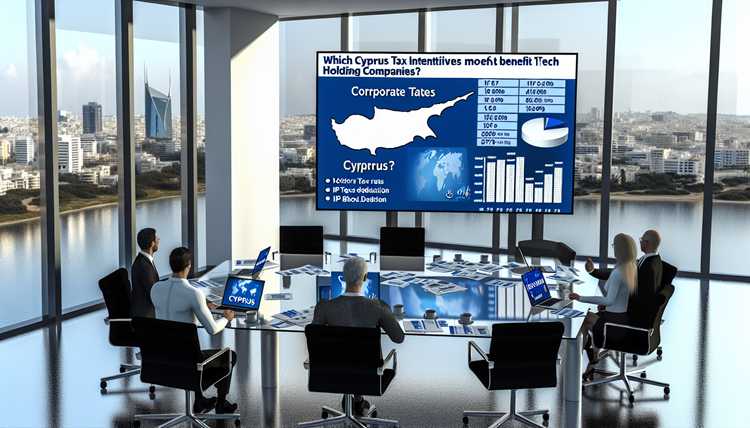
Which Cyprus tax incentives most benefit Israeli tech and holding companies?
Set up a Cyprus holding company as the group parent to own IP and licensing streams. This structure aligns with a 15% corporate tax, unlocks a Notional Interest Deduction (NID), gives access to an IP Box, and enables a participation exemption for cross-border dividends and capital gains.
Cyprus imposes a corporate tax rate of 15% on taxable profits. There is generally no withholding tax on dividends paid to non-residents, which supports clean cross-border distributions to Israeli entities within the group.
With the NID mechanism, new equity funding for Cyprus-registered operations can generate a deduction on the notional interest charged. The rate mirrors local government bond yields and is updated periodically, delivering a predictable tax shield on fresh capital used to scale software, services, or IP development.
Qualifying IP profits fall under an IP Box regime with up to an 80% exemption from tax on net profits linked to IP assets such as software, patents, and certain marketing intangibles, provided you satisfy ownership and functional tests.
The participation exemption supports cross-border planning by offering relief on dividends and on gains from the disposal of shares in subsidiaries, subject to ownership thresholds and substance requirements. This is especially valuable for a tech group with Israeli subsidiaries and a Cypriot holding company.
Gains tax rules include a 20% capital gains tax on the disposal of immovable property located in Cyprus; gains on the sale of shares are typically exempt unless the underlying value derives from Cypriot property. This nuance influences long-term structuring of property and related assets.
Cyprus maintains a bilateral tax treaty network, including an agreement with Israel, which reduces withholding on cross-border payments for royalties and interest and provides relief from double taxation for flows between Israeli and Cypriot entities. This supports licensing, service charges, and intra-group fee arrangements.
For R&D-driven Israeli tech, Cyprus offers incentives for qualifying R&D expenditures, including an enhanced deduction or credit against taxable income in many cases. Structuring Cyprus-based units around core R&D activities can amplify this relief while preserving strategic control in Israel.
How to establish a Cyprus legal entity: documents, timelines, costs

Open a Cyprus private limited company (Ltd) with a Cyprus registered office and appoint a Cyprus-resident director or engage a service provider to fulfill the director and secretary roles, accelerating bank onboarding and ongoing compliance.
Documents you will need
For all natural directors and shareholders, provide valid passports (clear photo pages) and proof of address dated within the last 3 months. If a director or shareholder is a Cyprus or foreign company, supply certified copies of the corporate documents (certificate of incorporation, memorandum and articles of association) and a board resolution authorizing the new incorporation. Prepare the proposed company name and obtain name availability from the Registrar of Companies. Draft the Articles of Association and Memorandum, and arrange a Cyprus-registered office address and a local corporate secretary as required by local law. List initial share capital and the shareholding structure with details of all shareholders or their corporate equivalents. If you plan to use non-English documents, arrange translations into English (or Greek) and have them legalized or apostilled for use in Cyprus. Compile beneficial owner information (names, addresses, ownership percentages) to satisfy AML obligations. If any documents are signed abroad, consider a power of attorney to authorize a Cyprus-based agent to finalize filings on your behalf. When documents originate outside the EEA, obtain apostille or legalization as applicable and ensure all filings reflect accurate, up-to-date information.
Timelines and costs
See also: Valentinos Polykarpou and Limassol.
See also: Speech by Deputy Minister Dr Nicodemos Damianou.
Names checks and availability typically take 1-2 days; document preparation, signing, and legalization may require 3-7 days; submission to the Registrar of Companies usually yields a certificate of incorporation within 7-14 days, with faster options available through dedicated service providers. In practice, complete setup often lands in a 2-3 week window if all documents are ready and translations are complete; expedited processing can reduce this to about 5 business days.
Cost snapshots: the Cyprus Registrar of Companies charges a filing fee in the low hundreds of euros for private limited registrations (roughly €350-€450). Professional setup fees from law firms or corporate service providers typically range €1,000-€1,800, depending on complexity and inclusion of services (notary, translations, bank liaison). Additional one-off costs may include bank introduction fees, notary fees, and translations (€200-€800 total).
Annual ongoing expenses include the Registrar’s annual levy (about €350), corporate secretary and registered office services (€300-€800 per year), and accounting/audit costs that vary by turnover and entities–commonly €1,200-€3,000 per year for a small private company. VAT registration is optional and depends on turnover; plan for periodic accounting, payroll, and corporate tax compliance as part of the annual cycle.
What immigration, visas, payroll arrangements support staff relocation?
Begin with a Cypriot work permit for each non-EU employee via the Labour Department, and file the temporary residence permit with the Migration Department in parallel. The sponsoring company submits the application and provides the signed employment contract, corporate registration documents, evidence of qualifications, and a clean criminal record. Prepare applications for dependents as well–spouse and children–along with marriage and birth certificates, certified translations, and proof of suitable accommodation.
For rapid mobility, use intra‑company transfer (ICT) permits when the Cypriot entity sponsors the move and the assignment fits internal transfer rules. Ensure the employee has an ongoing contract and an internal transfer letter from the parent company, and document salary alignment to meet permit criteria.
The Cyprus Startup Visa serves Israeli founders and key engineers joining a Cyprus‑registered startup. Provide the business plan, evidence of funds, a local employment offer, and a clear relocation rationale tied to the startup’s operations in Cyprus. Begin this path if the project has robust funding and a desk for the team in Cyprus.
Documents you’ll need include the employment contract, proof of corporate registration, evidence of qualifications, police clearance, and for family members: marriage and birth certificates with certified translations, plus proof of accommodation and health insurance coverage. Start gathering these early and organize translations to avoid delays during visa processing.
Timelines vary: work-permit decisions typically span several weeks to months. After approval, complete the residence-permit step and coordinate travel plans for you and your team. Build a buffer into onboarding to ensure a smooth relocation and immediate integration into Cypriot operations.
Payroll for relocated staff requires choosing between a local subsidiary or a trusted payroll outsourcing partner. Register the employee with the Tax Department for payroll withholding, with Social Insurance Services, and with the General Healthcare System (GHS). Run monthly payroll, issue clear payslips in English, maintain records, and prepare annual salary statements. If you relocate from Israel, leverage the Cyprus–Israel double taxation treaty to optimize cross-border tax treatment and avoid double taxation.
Visa options and timelines
Standard work permit: employer sponsorship is required; processing typically spans six to twelve weeks, depending on backlog and documentation completeness. When approved, extend to a residence permit for employed non‑EU nationals and align onboarding accordingly.
Intra‑Company Transfer (ICT) permit: designed for moves within the same corporate group; requires evidence of ongoing employment, an internal transfer letter, and salary alignment; processing can be faster than a standard permit, often around four to eight weeks.
Cyprus Startup Visa: targets founders and critical staff; requires a solid business plan, proof of funds, local employment agreement, and registration of the company in Cyprus; timeline ranges from a few weeks to several months depending on case complexity.
Payroll essentials and compliance
Set up a Cyprus payroll path via a local subsidiary or a payroll service provider; register each employee with the Tax Department, Social Insurance Services, and the General Healthcare System. Run monthly payroll on a fixed schedule, with accurate income tax withholding, social‑insurance contributions, and GHS deductions. Issue payslips in English, keep detailed payroll records, and prepare annual salary statements for each assignee. Coordinate with a tax advisor to confirm cross‑border residency status and to maximize benefits under the Cyprus–Israel double taxation treaty.
Where savings appear: comparing office, salaries, professional services
See also: Evgenios Evgeniou.
Lease flexible office space in Cyprus and route IP-heavy activities through a Cyprus entity to access IP Box and NID benefits. Pair this with disciplined cost controls in salaries and professional services to maximize after-tax savings.
Office costs
- Office strategy: Favor flexible leases, such as co-working or serviced offices, to match space with project milestones and avoid long commitments.
- VAT treatment: If VAT-registered, recover input VAT on rent and related services that relate to taxable activities; keep invoices organized for compliance.
- Location considerations: Limassol and Nicosia typically offer competitive rents and talent pools; negotiate inclusive packages that cover fit-out, maintenance, and utilities.
Salaries
- Payroll routing: Manage salaries through a Cyprus entity for eligible activities, enabling deductions tied to Cyprus-based costs and incentives.
- Notional Interest Deduction (NID): Utilize NID on new equity to reduce taxable base; example: with a €1,000,000 new equity and a 3% rate, the deduction is €30,000, yielding a tax saving of about €4,500 at 15% corporate tax. Exact figures depend on rate and structure.
- R&D and IP-focused roles: Concentrate development and IP-focused staff in Cyprus where eligible deductions and the IP Box apply; document roles and costs clearly for transfer pricing and tax purposes.
- Intercompany arrangements: Use arm’s-length service agreements for secondments or shared services with Israeli entities to reflect actual costs and preserve deductibility.
Professional services
- Local providers: Engage Cyprus-based legal, tax, and accounting firms with deep experience in IP Box and NID regimes to optimize structuring and compliance.
- IP Box mechanics: Qualifying IP profits receive an 80% exemption; the remaining 20% is taxed at the standard rate (15%), yielding an effective tax on IP profits around 2.5%. Track development, protection, and registration costs to maximize eligible profits.
- Documentation and TP: Maintain robust transfer pricing documentation, licensing agreements, and cost-sharing arrangements to support intercompany charges and eligibility for incentives.
- Cost visibility: Use bundled or milestone-based billing with service providers to keep costs predictable and align them with milestones of IP development and licensing cycles.
Example scenario: IP profits €2,000,000 with 80% exemption leaves €400,000 taxable at 15% ⇒ €60,000 tax. If €1,000,000 of new equity triggers a 3% NID deduction, that adds €30,000 of deduction, saving about €3,750 in tax. The combined effect highlights how office, salary, and services choices amplify the benefit of Cyprus incentives for Israeli tech and holding structures.
Ready to set up your Cyprus company?
Our specialists guide you through the entire process — registration, tax setup, and bank account opening.
Request a consultation →