

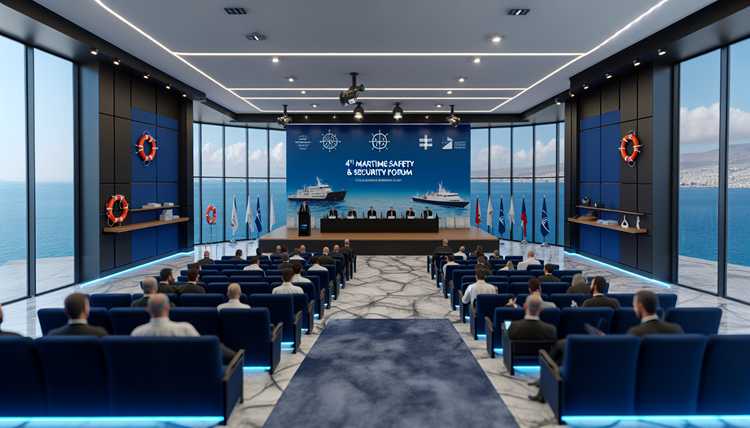
4th SAFETY4SEA Limassol Forum - Maritime Safety & Security
Attend the 4th SAFETY4SEA Limassol Forum to strengthen your crew safety playbook with actionable, field-tested insights. The program features 18 sessions, 6 workshops, and 12 conversations with practitioners from 25 nations, focusing on practical operations, security coordination, and regulatory updates.
In-context analysis shows how popularity-sampled data informs measures to contain risk across vessel and port operations. Attendees will explore approaches that integrate shipboard sensors, port data, and crew reporting into a cohesive dashboard, with modelling teams presenting computed indicators that translate risk into concrete controls.
john parani leads a session on dequantization techniques for noisy sensor streams, turning large-content feeds from navigational aids into reliable signals. The discussion will highlight how conversations across operations, security, and regulatory teams can be mapped to practical actions, with in-context case studies that show achieved improvements.
For organizations ready to act, prepare a 90-day pilot: define risk containment metrics, assign data-sharing roles, and establish a cross-ship risk board. Use practical templates to contain data leakage and ensure compliance, then review computed results against KPIs in the final session.
Hierarchical active binocular vision pipeline: from capture to autonomous scene exploration at sea
Recommendation: deploy a hierarchical active binocular vision pipeline that starts with stereo capture and ends in autonomous scene exploration at sea, combining a fast gaze controller (sub-30 ms) with a strategic exploration planner (2–5 Hz). Configure cameras at a 0.28-meter baseline, 1920×1080 resolution, 60 fps, and fuse data with an IMU to hold movements steady and to preserve a center reference. tons of sea trial data feed both levels, enabling dozens of attribute maps such as depth, texture, motion, and target probability. Classical approaches suffer from limited field of view and glare-induced losses; their disadvantages become acute under rough seas. Inbetweening interpolation fills gaps when frames drop, preserving continuity in depth and motion cues. We utilize interpretable models from huggingface for depth estimation and anomaly detection, improving operator trust. Research by rodrigo and hamed in chartered vessel tests demonstrates how austria-based teams and hannover collaborators reflect real-world variability. The programming workflow formats interfaces around a center, and holding the same reference frame even as the hull heaves. The pipeline develops a modular data flow with clear attribute streams, supporting scalable deployment across ships and centers.
Key components and data flow
Stereo capture streams power rectification, disparity estimation, and depth generation. We fuse depth with motion and texture attributes to feed the high-level planner, which selects 2–4 exploration targets per cycle; a low-level gaze controller performs center-shifted adjustments to maximize information gain while maintaining stability. The system utilizes numbers of features per frame (roughly 50–150 salient points) and hundreds of thousands of training samples gathered during trials to train robust models. Abnormalities such as reflections, foam columns, or sensor drift trigger safe-fail routines and automatic recalibration. hugggingface models provide interpretable depth and anomaly detection, while field tests led by rodrigo and hamed on chartered vessels validate the approach. Cross-border collaboration with Hannover and austria-based teams increases reliability and helps align programming interfaces across centers. This architecture supports exploration of scene segments in a structured, scalable manner, reducing operator load while expanding the situational picture and reflecting emerging techniques in autonomous maritime perception.
Sensor configuration, calibration, and synchronization for robust maritime perception
Configure a high-performance sensor backbone with a unified clock and hardware time-stamping across all channels. Use IEEE 1588 PTPv2 as the primary sync protocol, disciplined by GNSS and quantum timing references, to achieve approx sub-millisecond alignment between radar, EO cameras, LiDAR or millimeter-wave sensors, AIS, and sonar. This setup yields a green advantage by reducing redundant sampling and tightening fusion windows. In former projects, teams such as franco, tulika, cowley, faedo, and mahesan collaborated to define node layout and reference frames, aligning to clear standards and oard guidelines.
Establish a calibration workflow with three pillars: intrinsic calibration for EO/IR cameras and LiDAR, extrinsic calibration to align sensor frames to the vessel reference frame, and time-offset calibration to synchronize timestamps in the fusion queue. Capture parameters as reformulations of sensor models and store them in a standards-compliant database. Use plots to track drift, and set objectives that determine when re-calibration is required; target pose errors below a fixed threshold appropriate to sensor baseline and mission profile.
Implement a robust synchronization and fusion pipeline. Maintain per-sensor buffers, time-align data to a common clock, and apply motion compensation during fusion. Choose a fusion strategy (Kalman, factor graph, or Bayesian) based on mission needs, and monitor the time offsets with live plots. Display fused objects with per-sensor contributions and confidence, so operators can verify decisions at a glance. The intention is to minimize false positives and ensure stable performance in dynamic sea states.
Operational considerations and governance. Specify hardware-and-software requirements using standards-labeled templates, including optional retail-grade sensors for cost-constrained deployments. Plan maintenance windows, calibration cadences, and training across multi-nation teams, such as those involving bousounis and biorichard, to ensure reproducibility. Use a dashboard to track project progress, with objective display of metrics, and document reformulations of models as the system evolves. The plots and data back up the advantage of this configuration, and re-use across projects helps sustain progress toward the overall objectives and intention of the platform.
Object appearance learning: modeling, updating, and recognition in dynamic ocean environments
Adopt a modular baseline training plan that continuously updates object appearance models from streaming sensor data and surfaces real-time recognition confidence to operators.
Modeling should be built around a layered representation that handles unstructured backgrounds and surface cues, while incorporating integrated temporal context. Designing interfaces for shared features across affiliated teams enables local vessel data from home bases to feed the unified baseline. Draw on insights from menzies researchers located in the alpes region to strengthen the model's robustness to spray, glare, and rough seas. Ensure the representation supports foraging patterns and maintains reach across multiple platforms, from small boats to offshore vessels.
Update mechanisms should blend online adaptation with periodic retraining, and manage a lack of labeled samples by leveraging unstructured data and an organized housing for samples. Create an assistance workflow where operators can respond to misclassifications via a simple query interface, enabling rapid human-in-the-loop corrections. The governance remains organizational, with affiliated partners contributing to the shared baseline and ensuring data usage aligns with safety guidelines.
Evaluation should measure accuracy, satisfaction, and latency; test on local harbor scenes and open-water surface views; use a scale of tests from small-scale experiments to large, distributed trials. Use eventbrite for coordinating hands-on workshops and dissemination across teams; track usage metrics such as the rate of successful recognitions and the reduction of false alarms. Include womens participation in validation to broaden perspectives and reduce bias.
In deployment, apply an integrated pipeline that fuses surface imagery, radar, and AIS data; deploy voita analytics on edge devices to minimize bandwidth and latency. Maintain a local data fabric with strict data-hungry pipelines that feed into a shared repository; ensure the housing layer supports quick retraining. For future iterations (fourth iteration), emphasize design changes that scale to additional regions and to more diverse vessels, while preserving a strong query capability for operators to request clarifications or bring in human assistance.
Operational use cases: vessel detection, obstacle identification, and security monitoring workflows

Adopt a modular, three-layer workflow that couples vessel detection, obstacle identification, and security monitoring; set a keyword-driven labeling standard, enforce explainability, and ensure consistency across sensors and platforms. todays maritime operations demand that operators distinguish benign traffic from potential threats and respond within seconds. The approach relies on a unified toolset and clearly defined roles; the most impactful factor for reliability is robust data governance built from valid constituents of each sensor stream.
Vessel detection combines radar, EO/IR, and AIS feeds with sensor fusion and regularization to stabilize performance under changing weather and sea states. Use a keyword-driven annotation scheme to harmonize labeling across shifts, and provide explainability that shows how the model maps observed patterns to vessel categories. The system should keep false alarms in check by validating vessel hypotheses against contextual cues such as speed, heading, and proximity, distinguishing legitimate targets from clutter.
Obstacle identification emphasizes obstacles in the vessel path: static hazards, drifting debris, and other ships entering the detection zone. Build 3D localization and tracking, with a sense of distance and time-to-impact that informs decision support. Factor in near-field dynamics and lane adherence; aggregate risk scores from multiple inputs to support operator judgment. Abstractive features can help generalize from known obstacle types; apply regularization to reduce sensitivity to transient noise while preserving responsiveness.
Security monitoring workflows
Security workflows translate detections into timely alerts and auditable actions. Align with legislation and privacy constraints, ensuring data retention and chain-of-custody practices for investigations. Highlighting the rationale behind alerts supports operator trust and regulatory review. Use a standard risk score as a tool to prioritize responses; maintain consistency across teams by documenting keyword-based labeling, detection thresholds, and escalation paths. Most incidents rely on a small set of core factors: proximity, movement patterns, and context within the mission plan. In practice, drills with magdalena and melonie, held under progressively challenging conditions, empower operators to graduate to higher-skill responses. Short breaks with decorated drinks during exercises help maintain focus, going forward, todays teams empowered to act and sustain operational continuity regardless of weather or traffic mix.
Evaluation plan: metrics, field trials, and integration with maritime safety operations
See also: Understanding the Legal Framework for Wrapping DAO....
See also: Offshore Crewing Best Practices.
This plan will entail three synchronized streams: metrics, field trials, and operational integration. It defines a house for data governance, with having sensors, ships, and crews contributing inputs while preserving permits and privacy. The approach draws on technion research and involves authors diana, suchana, and johns to guide the assessment. We will summarize findings, present them in graphs and plots, and feed practical insights into the operational workflow behind frontline desks. The workflow emphasizes annotative notes to track scenario context and flags for obfuscation where needed. We will rely on a solid foundations and ensure assurance across stages, with permits in place and a press-ready narrative for marketplace discussions.
Metrics and data flow
Define metrics that map to maritime safety outcomes: reliability of detection, timeliness of response, and resilience under adverse conditions. The plan defines the data flow from sensors to operations dashboards, with edges in the data graph and outputs that decision-makers read quickly. We will summarize outputs with graphs and plots for rapid review. The approach includes gender-disaggregated indicators and emerging risk signals to capture diverse conditions. The mechanism features obfuscation controls for sensitive data and annotative notes to keep scenario context clear. Foundations for governance are explicit, and assurance checks align with permits and regulatory expectations. A myocardial assessment analogy helps stress the detection mechanism under simulated load, ensuring the flow remains reliable behind the scenes.
Field trials and integration with maritime safety operations
See also: Map Kalloni-inspired treatments toward tangible spa rituals....
Execute staged field trials across three ports to test the mechanism in realistic conditions. We define a data flow plan, with outputs tailored for the operations center. The trials feed into the marketplace of practices, and we prepare a press kit to communicate progress without exposing sensitive data. The authors diana, suchana, and johns will review results; technion provides technical validation. Permits and governance foundations guide access and data sharing. Annotative logs capture context for each scenario, reducing obfuscation risk and enabling reliable post-hoc analysis. We summarize lessons learned and plot them against defined KPIs to drive a faster adaptation cycle.
Ready to set up your Cyprus company?
Our specialists guide you through the entire process — registration, tax setup, and bank account opening.
Request a consultation →