

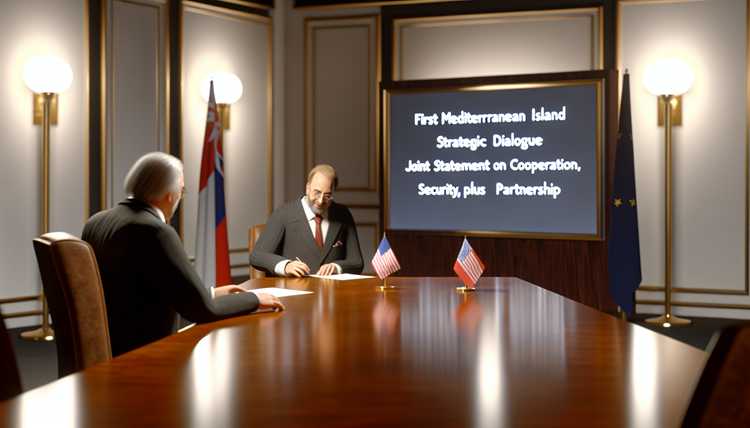
First Cyprus–U.S. Strategic Dialogue - Joint Statement on Cooperation, Security, plus Partnership
Action recommended: establish a standing Joint Steering Group (JSG) with quarterly meetings and a published road map for 2025–2027. The JSG will be co-chaired by the Cypriot Deputy Minister of Defense and the U.S. Assistant Secretary of State for European and Eurasian Affairs, and it will oversee concrete annexes on cybersecurity, maritime security, and energy resilience.
Next, launch 12 working groups with clear deliverables: a Cyber Annex by Q2 2026, a Maritime Security Protocol by Q3 2026, and an Energy Diversification Arrangement by Q4 2026. Each group will publish biannual progress reports and align with EU and NATO partners where appropriate.
For security cooperation, adopt a tested approach to information sharing, with a bilateral code of conduct and joint exercises. Reserve two joint drills per year focusing on anti-access/area denial (A2/AD) compatibility, search-and-rescue, and disaster response. Create a revolving fund for immediate joint capacity-building projects with a cap of $30 million annually.
Economic and people-to-people ties: promote port and airport cooperation, streamline visa processes for essential personnel, and expand higher-education exchange programs to 1,000 Cypriot students by 2028.
Measurement and transparency: publish a Joint Implementation Timeline with quarterly metrics, and set up a public-facing dashboard to track milestones against the roadmap. This ensures accountability and invites civil society input through annual public briefings.
Concrete Security plus Defense Commitments: Implementing the Joint Statement
Establish a Joint Implementation Unit (JIU) co-chaired by a Cypriot official and a U.S. counterpart, empowered to drive all action items, track milestones, and publish a shared plan with quarterly milestones and public summaries on non-sensitive progress.
Set up a secure threat intelligence framework that enables timely sharing of cyber and hybrid threats, with defined data handling rules, a common incident response playbook, and monthly briefings between defense and cyber teams. The framework should include a secure portal, standardized report formats, and a one-week after-action review after incidents.
Design and execute regular training and exercises: a yearly full-scale defense drill, quarterly tabletop exercises on contingencies, and short joint training blocks. Place liaison officers at major commands and create shared curricula so both sides practice interoperability under realistic conditions.
Harmonize defense procurement and maintenance through a bilateral framework: adopt interoperable standards, align spare-parts stock and logistics planning, and create a joint testing facility to certify equipment before fielding. Set a 90-day window to finalize collaborations on initial projects, with quarterly cost and readiness reviews.
Strengthen domain surveillance and response in maritime and air spaces: exchange patrol data, coordinate response to incidents, and establish joint watch points at critical hubs. Implement a bilateral SAR data-sharing protocol and exercise coordinated evacuations and search-and-rescue missions twice per year.
Codify governance and accountability by drafting an Implementation Protocol within six months, plus annual progress reports and a clear dispute-resolution channel. Attach timelines and responsible offices for every commitment to reduce ambiguity and ensure steady progress.
Measure success with concrete metrics: drill completion rates, time-to-contain incidents, readiness indices for critical systems, and training hours logged by personnel across both sides. The JIU should present data transparently and adjust actions in response to trend analyses.
Engage civilian resilience and critical infrastructure protection by aligning civilian-military emergency plans, sharing public communications templates, and coordinating joint exercises that include industry and local authorities. This ensures that communities are safeguarded during disruptions while maintaining steady security posture.
Strategic Coordination Framework: Roles, Timelines, alongside Contact Points
Establish a Joint Cyprus–U.S. Strategic Coordination Office within 14 days, with a formal charter, deliverables, and a bi-national staff of 12 across policy, security, and information-sharing functions. The office reports to the U.S. Ambassador in Cyprus and the Cypriot National Security Advisor, and it will publish a rolling 12‑month work plan with quarterly milestones and owner assignments.
Core roles and responsibilities are delineated to ensure alignment and actionability:
Policy alignment and joint planning synchronize defense, diplomacy, and economic measures through a standing Steering Group with monthly reviews.
Operational security cooperation and training coordinate exercises, equipment interoperability, and border security improvements on a quarterly cadence.
Crisis management and rapid communications ensure a 24-hour escalation path, a shared incident response playbook, and pre-flagged liaison channels for high-threat scenarios.
Economic and energy security coordination pursue diversification of suppliers, energy resilience, and sanctions/compliance coordination through a dedicated Economic Security Council.
Cyber and maritime security coordination integrate threat intelligence, critical infrastructure protection, and joint best-practice sharing in regular sessions.
| Role | Description | Lead Contact | Interaction Frequency | Milestone Timeline |
|---|---|---|---|---|
| Strategic Policy Alignment | Synchronize defense, diplomacy, and economic policy between the two partners through a standing Steering Group; produce a policy horizon and a memo on joint positions. | U.S. Embassy Political Counselor; Cyprus National Security Council Secretary | Monthly | Policy alignment report in 3 months |
| Operational Security Cooperation & Training | Coordinate exercises, defense interoperability, and border security enhancements; align procurement and training standards. | U.S. Defense Attaché; Cyprus National Guard Chief of Staff | Quarterly | First training cycle completed within 6 months |
| Crisis Management & Rapid Communications | Maintain a 24/7 escalation path, a shared incident response playbook, and pre-cleared liaison channels. | Senior Crisis Advisor (U.S.); National Security Advisor (Cyprus) | As needed | 12-hour notification protocol tested within 2 months |
| Economic & Energy Security Coordination | Coordinate diversification of suppliers, energy resilience planning, sanctions/compliance oversight. | U.S. Economic Counselor; Cyprus Economic Minister | Quarterly | Joint economic security assessment delivered in 4 months |
| Cyber & Maritime Security Coordination | Share threat intelligence, protect critical infrastructure, and run joint exercises for cyber and maritime domains. | U.S. Cyber Policy Lead; Cyprus Maritime Security Commander | Monthly | First joint cyber exercise within 5 months |
See also: What visa routes alongside residency schemes attract....
See also: KV Fund.
See also: Clélia Chevrier Kolačko.
Contact points and protocols establish a primary and alternate points of contact on both sides to enable rapid coordination. Primary: U.S. Embassy Cyprus – Defense Attaché Office; Secondary: Cyprus National Security Council – Chief of Staff; Alternate: U.S. Mission Cyprus – Political-Military Affairs Chief. Use a dedicated secure line and encrypted email for routine updates; schedule weekly coordination calls in month 1 and then biweekly thereafter, with on-call coverage for crisis events.
Economic, Trade, also Technology Cooperation: Sectors, Partners, and Innovation
Launch a bilateral plan focusing on three pillars: energy transition, IT and cyber security, and life sciences, with 2–3 pilots by 2026 and milestones for services trade.
Priority Sectors for Cooperation
Energy transition: co-design grid modernization, energy storage solutions, and green hydrogen pilots; set up two to three cross-border pilots by 2026 and establish procurement channels for equipment from U.S. suppliers.
Information technology and cybersecurity: create two joint development labs for secure software, AI risk management, and supply-chain integrity; implement a cross-border data-sharing framework with clear rules and review cycles.
Life sciences, health tech, and biotech: align on clinical research networks and tech transfer; launch two to three joint ventures and a shared clinical study platform to accelerate promising candidates to the market.
Maritime logistics and trade facilitation: digitize shipping documents, advance port automation, and adopt tracking and ETA systems; pilot a cargo-tracking corridor connecting a Cypriot port with a U.S. gateway within 12–18 months.
Partners, Funding, and Innovation Ecosystem
Establish a quarterly bilateral steering group to oversee programs, allocate resources, and adjust milestones.
Create a Bilateral Innovation Fund with a target range of €50–70 million over five years to support pilots, early-stage ventures, and joint research activities.
Forge academic and research ties with leading U.S. universities and national labs; host an annual joint symposium at the Cyprus University of Technology and a partner U.S. institution to share results and train researchers.
Support talent mobility through researcher exchanges and student internships: aim for 150 researcher exchanges and 200 student internships over a five-year period; pair programs with industry mentors and industry-sponsored projects.
Adopt a streamlined IP framework to clarify ownership, license terms, and revenue sharing for cross-border innovations, reducing time to market for co-developed technologies.
Energy Security plus Critical Infrastructure Protections: Joint Programs besides Milestones
Adopt a Bilateral Energy Resilience Platform (BERP) to synchronize grid data, coordinate response, and share threat intelligence.
BERP links three utilities on each side via a secure, role-based data exchange and a common incident response playbook, enabling real-time status updates, anomaly alerts, and coordinated containment actions across cyber and physical domains.
Introduce the Cross-Border Critical Infrastructure Risk Registry (CIRCIR) to identify and track the most sensitive energy assets, including the Cyprus electricity distribution network, LNG terminal facilities, gas interconnections, storage hubs, and key subsea links. Each entry carries risk indicators, exposure scores, and recovery targets.
For each asset, CIRCIR specifies prioritized mitigations, responsible parties, and monitoring triggers. The registry updates annually with input from operators, regulators, and independent validators to ensure objectivity.
Establish a Joint Procurement and Standards Corridor that harmonizes equipment specs, testing protocols, and cyber safeguards for transformers, protection relays, meters, and control-system components. The corridor supports joint tenders, bulk ordering, and faster spare-parts delivery, cutting downtime during outages by 15–25% in early pilots.
Allocate a four-year funding envelope of approximately $140 million, with contributions split between the United States and Cyprus and with a portion open to private-sector co-financing. Use the budget for platform development, risk registry maintenance, procurement pilots, drills, and independent reviews.
Design annual joint training and exercises that simulate cyber-physical attacks, grid failures, and supply-chain disruptions. Include operators, security agencies, and first responders; measure improvements by time to restore service and the number of vulnerabilities closed after each exercise.
Setup a Bilateral Steering Committee, with quarterly reviews and four working groups: cyber protections, physical security, logistics resilience, and risk analytics. Track progress with quarterly dashboards and publish a concise annual results summary.
Key performance indicators cover MTTR for critical events, uptime improvements, incident response times, data latency, parts availability, and the rate of shared threat intel taking action. Integrate findings into policy advisories and regulatory requirements without delaying operations.
People-to-People Ties: Education, Cultural Exchange, including Civil Society Initiatives
Launch a joint Education and Cultural Exchange Fund with an initial allocation of $2 million for 2025–2027 to support short-term exchanges, faculty-led programs, and joint research trips. This fund should be matched 1:1 by Cypriot and U.S. partners, with transparent reporting and annual impact assessments.
Education Initiatives
Establish four exchange tracks: undergraduate study abroad, graduate research collaborations, faculty-led short courses, and virtual residencies. Each track specifies clear eligibility, a simple two-stage review, and a goal to reach broad participation across public and private universities in both countries. Create the Cyprus–U.S. Education Bridge portal to unify applications, deadlines, and outcome reporting, and pilot two joint degree programs within 24 months that pair Cypriot institutions with U.S. partners in STEM, health sciences, and business.
Complement exchanges with targeted teacher and professor training, short-term seminars on critical topics, and structured internships that place Cypriot students with U.S. firms or research centers for up to three months. Track success using completion rates, satisfaction surveys, and subsequent enrollment or placement in joint research or study programs.
Cultural Exchange and Civil Society
Fund community-led cultural projects, artist residencies, and civic initiatives that highlight shared values and local creativity. Host quarterly forums bringing together universities, NGOs, cultural institutions, and youth groups to identify joint action areas and publish annual impact briefs. Support at least five civil-society coalitions per year that address priorities such as media literacy, civic education, and volunteerism, with funding rounds that require co-financed contributions from partner organizations.
Monitoring, Reporting, meanwhile Next Steps: How Progress Will Be Tracked
Set up a Joint Monitoring Committee (JMC) within 30 days of the joint statement to track progress against defined indicators, approve data collection methods, and authorize public disclosures. The JMC should be co-chaired by the Cyprus Ministry of Defence and the U.S. Embassy’s Defense Attaché Office, with clear terms of reference and a fixed meeting cadence.
Framework elements ensure clarity and accountability. Define the scope to cover security cooperation, defense interoperability, energy security, economic resilience, and people-to-people exchanges. Build a core set of 8–12 measurable indicators across these domains to avoid drift and enable targeted improvements.
- Indicators span four domains: security cooperation, interoperability, energy resilience, and people-to-people programs.
- Each indicator has a baseline, a target for year one, and a forecast for year two.
- Assign a data owner from the respective ministry or agency and establish a reciprocal data-sharing arrangement with the U.S. counterpart.
Data sources are practical and verifiable. Pull figures from official progress reports, exercise logs, training rosters, procurement records, and energy security audits. Where possible, triangulate with third-party assessments conducted by independent reviewers.
- Official ministry reports and defense logs, including exercise outcomes and after-action reviews.
- Procurement and interoperability documentation, such as standardization compliance and joint doctrine alignment.
- Energy and critical infrastructure records showing diversification, redundancy, and resilience metrics.
- Independent evaluations where available, to verify accuracy and reduce bias.
Cadence and formats promote timely visibility. Maintain an internal, secure dashboard updated monthly, while issuing public progress reports quarterly. Use concise annexes to explain methodology, data quality controls, and any redactions for sensitive items.
- Monthly internal dashboard with milestone status, risk flags, and corrective actions.
- Quarterly public progress reports highlighting achievements, challenges, and next steps.
- Annual comprehensive review with independent input to refine indicators and targets.
Roles and responsibilities prevent gaps. Each indicator links to a lead agency, a data owner, and an escalation path for delays or data gaps. Establish a formal process to approve changes to indicators and targets when needed.
- Lead agencies: Ministry of Defence, U.S. Defense Attaché Office, energy ministry, and relevant departments for people-to-people programs.
- Data owners: designated civil service or military personnel responsible for data quality and timely submission.
- Escalation: quarterly review for any indicator missing its data by more than 15 days.
Tools support accuracy and speed. Implement a secure, access-controlled dashboard, automated data pulls, and alert notifications for missed milestones. Require standardized data formats to simplify cross-agency aggregation.
- Secure dashboard with role-based access for Cyprus and U.S. counterparts.
- Automated data collection from routine reports and logs where feasible.
- Automatic alerts for overdue data submissions or milestone delays.
Transparency and feedback drive trust. Publish redacted or summary versions of data where sensitivity limits full disclosure, and invite parliamentary committees, civil society groups, and industry bodies to review the public reports and submit questions.
- Redaction handles sensitive defense details while preserving public accountability.
- Quarterly public briefings accompany the release of progress reports.
- Feedback channels open for clarifications and suggested improvements.
Risk management keeps the plan resilient. Maintain a risk register with likelihood, impact, and mitigations. Trigger reviews when risk scores rise beyond a set threshold, and adjust timelines or resource allocations accordingly.
- Identify risks such as data gaps, funding fluctuations, or political constraints.
- Document mitigation actions and responsible parties.
- Review the register at each quarterly meeting and after major milestones.
Next steps and rollout provide a clear path forward. Follow a phased timeline that starts with governance setup and baseline data collection, then expands to regular reporting and public communication, with an annual refinement cycle based on independent input.
- Within 30 days: establish JMC, agree indicators, assign data owners, set baseline data collection procedures.
- Within 60 days: deploy the secure dashboard, publish the first internal progress snapshot, finalize the first public progress report outline.
- Within 90–120 days: publish the first public progress report; hold a high-level briefing with key stakeholders.
- Annually: conduct an independent review, update indicators and targets, and adjust resource plans as needed.
Specific tracking ideas keep progress concrete. Examples include the number of joint exercises completed and evaluated per year, interoperability milestones met (doctrine alignment, staff exchanges, shared training courses), procurement alignment with joint standards, energy-security improvements (diversification indices, contingency capacity), and the volume of people-to-people initiatives (scholarships, exchanges, professional visits).
- Exercises: count and assess outcomes, with lessons learned documented and acted upon.
- Interoperability: track doctrine updates, joint training schedules, and equipment standardization progress.
- Procurement: monitor alignment with shared standards and mutual-aity approvals.
- Energy resilience: log diversification steps, redundancy measures, and response drills.
- People-to-people: record engagements, participant numbers, and follow-on opportunities.
By sticking to these steps, both sides gain clarity, minimize delays, and create a clear line from actions to results. The framework enables rapid adjustments while keeping commitments concrete and verifiable.
Ready to set up your Cyprus company?
Our specialists guide you through the entire process — registration, tax setup, and bank account opening.
Request a consultation →