
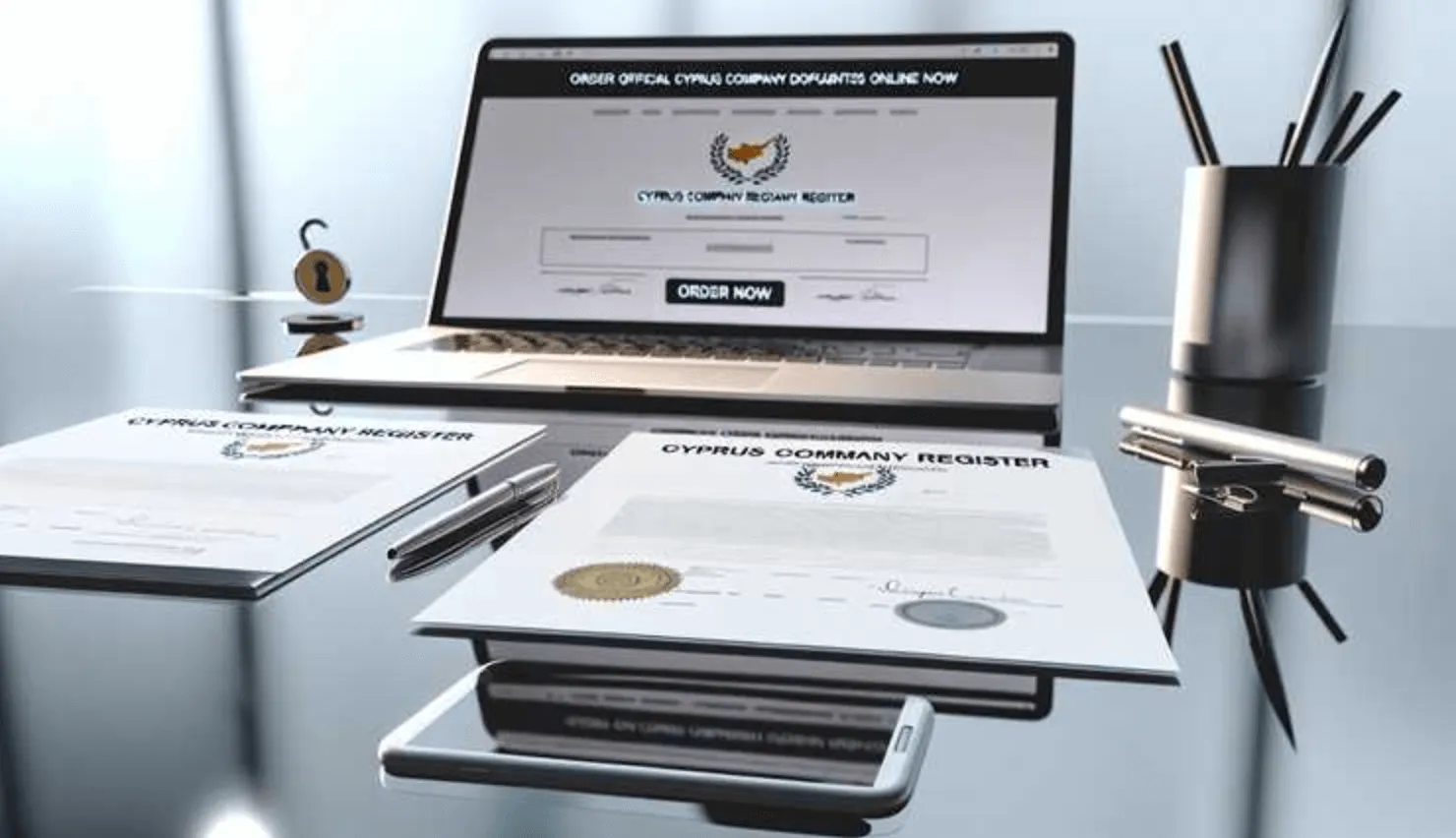
Order Official Cyprus Company Register Documents Online Now
Do this: pick the record type and enter the entity’s HE number; receive government‑stamped PDFs within 2–48 hours via a secure portal, or apostilled originals by tracked courier in 5–7 business days (global delivery 2–5 days).
What you can request: Certificate of Incorporation, Certificate of Good Standing, Directors & Secretary roster, Shareholder extract, legal address certificate, Memorandum & Articles, annual return HE32, name change certificate, charges ledger extract, historical profile with changes.
Best picks by purpose: KYC/banking–Good Standing + Directors/Shareholders + M&A; tenders–Good Standing + Incorporation + legal address; M&A/duediligence–full history, charges, latest HE32, M&A.
Pricing (EUR): PDF extract from €29; certified copy €79; apostille set €129; KYC bundle €169; 5+ entities −10%. Urgent handling available (as fast as 3–6 hours where the registry allows).
What we need from you: entity name or HE number, target use (banking, tender, audit), delivery preference (PDF, certified, apostille), recipient details for courier.
Assurances: issued by the government registry (CY), Hague apostille 1961, bilingual availability for many records (EN/EL), timestamps and seal/embossing on certified sets.
Choose the exact document you need: Certificate of Incorporation, Certificate of Good Standing, Directors & Shareholders Register, Certificates of Directors/Secretary, Memorandum & Articles, Certificate of Registered Office, Certificate of Name Change

See also: Order Cyprus Company Register Documents Online Now.
For bank onboarding, choose a Certificate of Good Standing dated within the last 30–90 days; request a notarised or apostilled original for cross‑border submission. Typical turnaround: scanned copy in 1–2 business days, sealed original in 3–7, apostille adds 3–5.
To prove legal formation, use the Certificate of Incorporation (shows name, number, and date of formation). Pair it with a Certificate of Name Change if the trading name differs from the original. For tender packs or tax registrations, include both.
To confirm legal address, select the Certificate of Registered Office. Add the most recent address change filing if the location was updated in the last 6–12 months. Many institutions request this together with Good Standing.
To verify management, obtain the Certificate of Directors & Secretary for current officers. If a counterparty needs signatory proof, add board resolutions or specimen signature pages where applicable.
To show ownership, request a Directors & Shareholders list/extract with current holdings and issue dates. If historic data is required, add a timeline of transfers or annual returns covering the requested period.
For legal review, get the Memorandum & Articles. Ask for a consolidated version that includes all amendments; if only the original text exists, add each amending resolution. Typical size: 15–40 pages. Certified translation can be added if the counterpart requires English.
For rebranding or M&A, include the Certificate of Name Change and ensure contracts reference both the former and current names. Pair with Good Standing to confirm continuity.
Format options: plain copy (scan), certified copy with wet‑ink seal, digitally signed PDF (where available), notarised, and apostilled. Choose apostille for use in Hague Convention jurisdictions; select notarisation plus legalisation for others.
What to provide: exact entity name, registration number, year of formation (if known), target country of use, whether apostille or translation is needed, delivery preference (scan/original), and your deadline.
Typical validity expectations: Good Standing and management/ownership extracts are commonly accepted if issued within 30–90 days; address and incorporation papers have no fixed expiry but should reflect the current status.
Need a quick pick? Banking/KYC: Good Standing + Directors/Secretary + Registered Office. Vendor due diligence: Good Standing + Incorporation + ownership extract. Legal opinions: Memorandum & Articles + management certificate + Good Standing.
Submit a compliant online request: required company name and HE number, date range or “as at” date, language (Greek/English), identity verification, payment methods, processing times

See also: Order Cyprus Company Register Documents Online Now.
Provide the exact entity name as listed on the public index and the HE number in the format HE123456; if the entity has been renamed or converted, include former names and the effective dates to avoid mismatches.
Select dates precisely: use a range (DD/MM/YYYY–DD/MM/YYYY) for filing histories and transaction logs, or a single “as at DD/MM/YYYY” for status snapshots (directors, shareholders, charges). For a full history, write “from incorporation to present.”
Choose language: Greek or English. If both are required, request a bilingual set; in this jurisdiction the Greek version prevails if any wording differs. For certified English outputs, ask for an official translation attached to the original Greek certificate.
Complete identity checks: attach a color passport or national ID and a proof of address (utility bill or bank statement) dated within 3 months. If applying on behalf of a legal entity, add an authorization letter on letterhead, signatory ID, and–if available–formation details and a power of attorney. Include a contact email and phone number for queries.
Payment methods: card (Visa/Mastercard), local gateway (JCC), Apple Pay/Google Pay where supported, or bank transfer (IBAN/SWIFT). Use EUR and reference the HE number in the payment description. Card payments post immediately (typical surcharge 1.5–2.5%); SEPA transfers may add 1–2 business days.
Processing times: instant to 30 minutes for standard e-extracts; 1–3 business hours for uncertified PDFs; 2–5 business days for certified copies; 5–10 business days for archive file retrieval. Expedited handling (24–48 hours) may be available for an extra fee; courier delivery adds 3–7 days depending on destination.
Quality checks before submission: verify the HE number matches the entity name via the public search; confirm the date format (DD/MM/YYYY); specify the language unambiguously; ensure ID scans are clear and uncropped; include all prior names where relevant; confirm payment proof is attached for bank transfers.
Common rejection causes and fixes: wrong HE format (prefix missing) → use “HE” + six digits; unclear date instruction → state one option only (range or “as at”); missing address proof → supply a document showing your name, address, and date; language not stated → add “Greek,” “English,” or “both” in the request note.
Get delivery and legalization right: certified PDF vs sealed original, courier options, notarization and Apostille, add-on translation, acceptance by banks, KYC, tenders, court filings
Choose a certified PDF for rapid KYC screening and e-portal filings; choose a sealed original if you need Apostille, consular legalization, or a wet-ink set for a court clerk. For financial institutions, keep issue date under 3 months; for public tenders, many evaluators accept up to 6 months.
Certified PDF vs sealed original
Certified PDF: issued with a qualified e-signature and time-stamp, usually delivered within 2–24 hours. Suitable for compliance pre-checks, vendor onboarding, and tender portals that accept uploads. Do not print: a printout loses cryptographic validity; instead, forward the native file so recipients can verify the signature and hash. Expect lower fees than physical sets. Acceptance: many banks accept e-signed registry extracts, Good Standing, and COI for initial review, provided the file carries a verifiable signature or QR/hash and is recent.
Sealed original: wet-ink signature and embossing or hologram; needed for Apostille, consular legalization, and courts that reject e-signatures. Typical pack includes COI, Good Standing, name/seat/capital certificates, and a recent extract of directors/shareholders. Request at least two sealed sets if multiple institutions will retain originals.
Legalization, translation, and delivery
Notarization: used when a sworn copy of a registry paper is required. Timeline: 1 business day for notarized copies of certificates and constitutional papers. Apostille: 1–3 business days after notarization or on a public officer’s signature; urgent same-day possible if lodged early morning. Consular route (for non‑Hague states): 5–15 business days after notarization, plus embassy lead time; confirm country‑specific fees and appointment slots.
Translation add‑on: provide sworn or notarized translations when the recipient’s language differs. Common pairs: English↔Greek, English↔Russian, English↔French, English↔German, English↔Arabic. Turnaround: 1–3 business days for up to 20 pages; larger sets scale by volume. For banks and courts, insist on translator’s seal and cross‑reference to certificate numbers and issuance dates.
Acceptance checklist by use case: Banks/KYC–COI, Good Standing, recent directors/shareholders extract; freshness ≤90 days; Apostille often required for cross‑border onboarding; PDF acceptable for pre‑approval, sealed original for final file. Tenders–portal uploads typically accept certified PDFs; some evaluators ask for a sealed set at award stage; verify freshness rule (often ≤180 days). Court filings–e‑filing systems may accept e-signed PDFs; for physical dockets, submit apostilled originals plus sworn translations if the court language differs.
Courier options: DHL/UPS/FedEx with tracking and delivery to business addresses only (no P.O. boxes). Typical transit: EU 1–2 days, UK 2–3, US/Canada 3–4, GCC 3–5, Asia‑Pacific 3–5, LatAm 4–6. Include a local contact number for customs queries. Request tamper‑evident packaging; do not unbind or separate pages–breaking the ribbon or eyelets voids the set. Add one spare sealed set if multiple departments (e.g., compliance and legal) will retain copies.
Cost‑saving tips: use a certified PDF for initial checks, then proceed with a single apostilled set once acceptance is confirmed. Bundle Apostille with translation in one run to avoid repeat handling. If timing is tight, send a scan of the sealed set for preliminary review while the courier is in transit.
Before requesting: ask the recipient to confirm 1) PDF with qualified e‑signature vs wet‑ink, 2) Apostille or consular path, 3) language of the file and translation requirements, 4) freshness window, 5) whether notarized copies are acceptable instead of multiple originals.
Q&A:
Ready to set up your Cyprus company?
Our specialists guide you through the entire process — registration, tax setup, and bank account opening.
Request a consultation →